
FUE vs. FUT Hair Transplant: Which Method Delivers Better Results

Hair loss is a common concern affecting millions of people worldwide. It can impact confidence, appearance, and self-esteem. Thankfully, modern hair transplant techniques like FUE vs FUT Hair Transplant provide effective solutions. Both methods are popular, but each has unique advantages, procedures, and outcomes. In this comprehensive guide, we explore the FUE vs FUT comparison, including procedure details, benefits, success rates, costs, results, and patient reviews. Understanding Hair Transplant Techniques: FUE and FUT Before diving into comparisons, it’s important to understand what FUE and FUT hair transplant procedures are. What is FUE Hair Transplant? FUE (Follicular Unit Extraction) involves extracting individual hair follicles from the donor area, usually the back or sides of the head, and implanting them into thinning or bald areas. It’s minimally invasive and does not leave a linear scar. Key Points About FUE Hair Transplant Procedure: Individual follicular units are harvested. Tiny dot-like scars, almost invisible after healing. Faster recovery time, usually 7–10 days. Ideal for short hairstyles and smaller areas of hair loss. Suitable for patients wanting minimal invasiveness. What is FUT Hair Transplant? FUT (Follicular Unit Transplantation), also known as strip surgery, involves removing a strip of scalp from the donor area. The strip is then dissected under a microscope into individual follicular units, which are implanted into bald or thinning areas. Key Points About FUT Hair Transplant Procedure: Strip of scalp removed, then dissected into grafts. Linear scar in the donor area (usually hidden by surrounding hair). Can harvest a larger number of grafts in a single session. Longer recovery time, approximately 10–14 days. Often preferred for extensive hair loss. FUE vs FUT Comparison: Technique, Recovery, and Scarring Understanding the differences helps patients make an informed decision. Here’s a detailed FUE vs FUT comparison: Feature FUE Hair Transplant FUT Hair Transplant Donor Harvest Individual follicles Strip of scalp Scarring Tiny dot-like, almost invisible Linear scar, may be noticeable Recovery Time 7–10 days 10–14 days Pain Level Minimal Moderate Hair Density Moderate, session-dependent High, suitable for large bald areas Best For Small to medium hair loss Extensive hair loss Cost Slightly higher per graft More cost-effective for large sessions Benefits of FUE and FUT Hair Transplant FUE Hair Transplant Benefits Minimal Scarring: Ideal for those who wear short hairstyles. Faster Recovery: Patients return to normal activities within a week. Less Invasive: Fewer stitches and less discomfort. Flexibility: Can be combined with other cosmetic procedures if needed. High Patient Satisfaction: Excellent natural-looking results with careful placement. FUT Hair Transplant Benefits Higher Graft Yield: Large areas can be covered in a single session. Better for Extensive Hair Loss: Provides dense coverage. Cost-Effective for Large Sessions: Less labor-intensive per graft. Precision: Microscopic dissection ensures high-quality grafts. Long-Term Results: Transplanted follicles are usually resistant to hair loss. FUE vs FUT Results: What to Expect Both FUE and FUT deliver natural results, but there are some distinctions: Hair Density: FUT can achieve slightly higher density per session due to the large number of grafts. Scarring: FUE leaves minimal visible scarring, whereas FUT leaves a linear scar that may show with very short hairstyles. Recovery: FUE patients experience quicker healing. Long-Term Growth: Both procedures provide permanent hair growth, with follicles resistant to future hair loss. Success Rates: FUE Hair Transplant vs FUT Hair Transplant Understanding success rates is crucial: FUE hair transplant success rate: 90–95%, depending on surgeon skill and post-operative care. FUT hair transplant success rate: 95–98%, especially effective in large sessions due to intact follicular units. Both methods are highly successful when performed by experienced professionals. FUE vs FUT Cost: How Much Should You Expect? Cost varies depending on clinic, location, and the number of grafts required. FUE vs FUT cost: FUE: Typically higher per graft due to labor-intensive extraction. FUT: More affordable for large sessions as strip harvesting is faster. While FUE is preferred for cosmetic reasons (minimal scarring), FUT can be more cost-effective for patients requiring extensive coverage. FUE vs FUT Reviews: Patient Experiences Patient feedback helps gauge real-world outcomes: FUE reviews: Emphasize minimal scarring, fast recovery, and natural-looking results. Patients appreciate freedom to style short hair after surgery. FUT reviews: Highlight high density and effectiveness for severe hair loss. Some note the linear scar but report high satisfaction overall. Factors to Consider When Choosing Between FUE and FUT Extent of Hair Loss: Small patches may benefit more from FUE; extensive baldness often requires FUT. Hairstyle Preferences: Short hair? FUE is better to minimize visible scarring. Budget: FUT may be more economical for large sessions. Recovery Time: FUE allows quicker return to work and social activities. Surgeon Expertise: Ensure the clinic has experience in both techniques for best outcomes. Frequently Asked Questions (FAQs) Q1. Which hair transplant method is less painful, FUE or FUT?A1. FUE is generally less painful due to minimal invasiveness and no linear incision. FUT may cause moderate discomfort during recovery. Q2. Can I wear short hairstyles after FUT?A2. FUT leaves a linear scar, which can be noticeable with very short hair. FUE is better if you prefer very short hairstyles. Q3. How long does it take to see full results?A3. Hair growth usually begins 3–4 months post-surgery, with full results visible after 9–12 months for both FUE and FUT. Q4. Are FUE results permanent?A4. Yes. Transplanted follicles are resistant to hair loss, making results permanent for most patients. Q5. Which is more cost-effective for large areas?A5. FUT is generally more affordable for extensive hair restoration because more grafts can be harvested in a single session. Q6. Can FUE and FUT be combined?A6. In some cases, surgeons may combine both methods for optimal coverage, especially in patients with significant hair loss. Final Thoughts: FUE vs FUT Hair Transplant When deciding between FUE vs FUT Hair Transplant, both procedures offer excellent results, but your choice depends on hair loss extent, lifestyle, and personal preferences: FUE: Ideal for minimal scarring, quicker recovery, and short hairstyles. FUT: Best for maximum graft yield, dense coverage, and extensive hair loss. Consulting an experienced hair transplant surgeon will
Guide to Hair Transplant

Hair loss is one of the most common concerns among men and women today. It can lower confidence, affect appearance, and even impact social or professional life. Many try oils, medications, and home remedies—but most of these give only temporary relief. If you are searching for a permanent solution to baldness or thinning hair, a hair transplant may be the answer. In this Guide to Hair Transplant, we’ll explain what it is, how it works, who is eligible, the different methods, costs, benefits, and why Arka Skin Clinic is the trusted choice for hair restoration. What is a Hair Transplant and How Does It Work? A hair transplant is a surgical procedure that moves healthy hair follicles from one part of your scalp (the donor area, usually the back or sides) to areas that are bald or thinning (the recipient area). The transplanted hair continues to grow naturally. It blends seamlessly with your existing hair. It offers a permanent and natural-looking solution. This procedure works because hair at the donor site is resistant to balding and keeps growing for life—even when moved to a new area. Who is the Right Candidate for a Hair Transplant? Not everyone with hair loss needs a transplant. You may be an ideal candidate if you: Have male or female pattern baldness. Have enough donor hair at the back or sides of your scalp. Are in good general health. Have stable hair loss (not rapidly worsening). We are looking for a long-term, permanent solution. Tip: Book a consultation at Arka Skin Clinic to check your eligibility and design a treatment plan that suits you. Different Types of Hair Transplant Techniques Explained There are two main types of hair transplant methods. Both have the same goal—restoring natural hair—but they differ in how follicles are extracted. FUT (Follicular Unit Transplantation): The Strip Method A small strip of scalp is removed from the donor area. Hair follicles are separated and transplanted to bald areas. Allows many grafts in one session but leaves a thin linear scar. FUE (Follicular Unit Extraction): The Modern Standard Individual hair follicles are directly extracted from the donor area. They are implanted one by one into thinning or bald regions. No stitches, minimal scarring, quicker recovery. Currently, the most preferred method worldwide. At Arka Skin Clinic, we specialize in FUE hair transplants, giving our patients safe, scar-free, and natural-looking results. Step-by-Step Guide to the Hair Transplant Procedure Wondering what actually happens during a transplant? Here’s a simple breakdown: Consultation & Hairline Design – Your doctor examines your hair loss and plans a natural-looking hairline. Preparation – Donor and recipient areas are cleaned and numbed with local anesthesia. Follicle Extraction – Healthy hair follicles are carefully removed (FUE or FUT). Implantation – Follicles are placed into bald areas using precise angles. Aftercare & Recovery – You’ll receive instructions and medications to support healing. The procedure is safe, and most patients feel little to no discomfort. Benefits of a Hair Transplant – Why It’s Worth It Choosing a hair transplant has life-changing benefits: Permanent solution – Transplanted hair grows for life. Natural appearance – Designed to match your original hairline. Low maintenance – Wash, cut, and style normally. Boost in confidence – Restores your self-image and presence. Cost-effective long-term – Saves money compared to repeated temporary treatments. Recovery After Hair Transplant – What to Expect Recovery is usually quick, especially with FUE. Here’s a timeline: Day 1–7 – Mild swelling or scabs; healing begins. Week 2–4 – Some shedding of transplanted hair (normal). Month 3–4 – New hair growth starts. Month 9–12 – Full, permanent results are visible. At Arka Skin Clinic, we provide complete aftercare guidance to ensure smooth healing and the best outcomes. Risks and Side Effects of Hair Transplant Surgery Hair transplants are generally safe when performed by experts. However, temporary side effects may include: Mild swelling on the scalp Temporary itching or scabbing Minor bleeding or soreness Shock loss (temporary shedding of nearby hair) These are short-lived and resolve with proper care. Choosing an experienced clinic like Arka Skin Clinic minimizes risks. Hair Transplant Cost in India – Factors You Should Know The cost of a hair transplant in India varies depending on: Technique used (FUE vs. FUT) Number of grafts required Doctor’s expertise Clinic’s location and facilities On average, prices range from ₹30,000 to ₹1,50,000 or more. At Arka Skin Clinic, we offer transparent pricing and personalized packages tailored to your needs. Why Choose Arka Skin Clinic ? Your choice of clinic is as important as the procedure itself. Here’s why patients trust us: Experienced doctors with proven expertise in hair restoration. Advanced technology for precision and safety. Natural-looking hairlines designed to suit your face. Hygienic, world-class facilities with strict safety standards. Affordable, transparent packages for all needs. At Arka Skin Clinic, we don’t just restore hair—we restore confidence. FAQs: Guide to Hair Transplant – Quick Answers Q1. Is a hair transplant permanent? Yes. Transplanted hair continues to grow naturally for life. Q2. Does the procedure hurt? No. It’s done under local anesthesia, making it painless. Q3. When will I see results? New hair starts growing in 3–4 months; full results in 9–12 months. Q4. Can women undergo hair transplants? Yes. Women with thinning or pattern baldness can benefit. Q5. Is hair transplant safe? Yes, especially when performed at a certified clinic by trained specialists. Conclusion This Guide to Hair Transplant shows that it’s the most effective, safe, and permanent solution to baldness and thinning hair. With modern techniques like FUE hair transplant, patients can expect natural results and quick recovery. At Arka Skin Clinic, we combine medical expertise, advanced technology, and personalized care to give every patient the confidence they deserve. 👉 Book your consultation today at Arka Skin Clinic and take the first step toward a fuller, confident you.
Advantages and Disadvantages of Hair Transplant
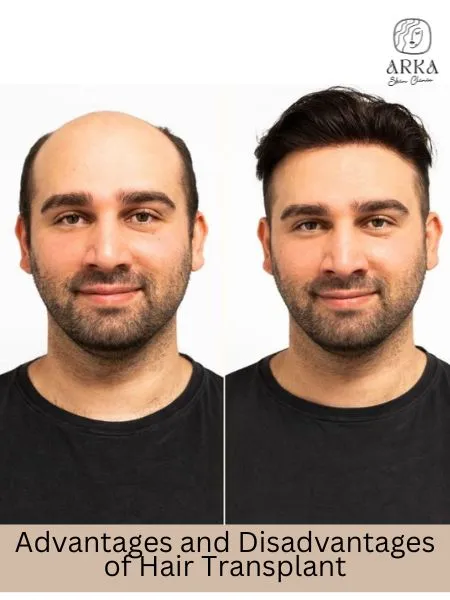
Hair loss can affect our confidence and overall presence, making several people find effective and permanent solutions. A hair transplant is one such option that has extended approval due to its natural-looking results. This blog will discuss the main parts of hair transplantations, including their benefits, possible problems, and other related issues. What is a Hair Transplant? A hair transplant is a medical process in which hair follicles are inspired from one part of the body from the back, sides of the scalp, or thighs to areas facing thinning or hairless. The two common methods used for hair transplantation are: Advantages of Hair Transplant Hair transplants use your hair, protecting the new growth that blends perfectly with the rest of your hair. The results are permanent and natural. Temporary solutions like extensions or medicines, and a hair transplant provide a continuing solution. Once the transplanted hair grows, it stays for life. Transplanted hair requires no special maintenance. You can pleasure it just like your natural hair-wash, style, and cut it as you wish. Re-forming your hairline can improve your presence and self-confidence, making you feel more confident in social and professional environments. Hair transplant actions are generally safe and are performed under local anesthesia, minimizing risks and lost time. Disadvantages of Hair Transplant Hair transplant actions can be exclusive. The cost differs based on the clinic, the surgeon’s knowledge, and the level of the process. While just offensive, a hair transplant still requires time to heal. You might experience swelling, redness, or coatings in the treated area for a few weeks. A hair transplant may not be an option for individuals with general baldness. A consultation with a dermatologist is important to control suitability. Possible side effects include infection, marking, or unnatural hair growth if the process isn’t done correctly. Choosing a skilled dermatologist can minimize these risks. In some cases, especially for larger smooth areas, multiple sittings may be required to reach the desired results. This can increase both the cost and time promise. How to Choose the Right Clinic Finding the right clinic and dermatologist is crucial for a successful hair transplant. Here are some tips to help you find the best option: For residents in Gurgaon, finding the best dermatologist is easy with several reputed clinics offering personalized care. Conclusion A hair transplant can be a life-changing procedure for those stressed with hair loss. It offers natural, long-lasting results that boost confidence and improve your appearance. However, it is essential to balance the advantages and disadvantages, understand the costs involved, and choose a trusted clinic for the best outcomes. If you are considering a hair transplant in Gurgaon, consult the best dermatologist for expert guidance and personalized treatment. With the right care and expertise, you can achieve a fuller, healthier head of hair and restore your confidence. FAQs Is a hair transplant permanent? Yes, hair transplants provide a permanent solution as the displaced hair is modest to the effects of balding. Does the procedure hurt? The process is done under local anesthesia, so pain is nominal. Some uneasiness may occur during recovery. How long does it take to recover from a hair transplant? Most people recover within 7-10 days, but it may take a few months to see full results as the hair grows. Are there any risks? Like any surgery, there are risks such as infection, scarring, or unusual growth patterns. These risks are minimized by choosing an experienced dermatologist.